The Tibetan Centre for Human Rights and Democracy (TCHRD) launched its 2025 Annual Report on the Human Rights Situation in Tibet in Tibetan, English, and Chinese at a press conference at its office in Dharamshala, India. The report documents the worsening human rights crisis in Tibet under the People’s Republic of China throughout 2025. As Chinese authorities intensify efforts to consolidate political and ideological control, Tibetans continue to face severe restrictions on their fundamental freedoms, including religion, expression, education, cultural identity, and peaceful dissent.
In 2025, Tibet continued to remain one of the least free places in the world, receiving a Global Freedom Score of 0 out of 100 by Freedom House. Under the continued leadership of Xi Jinping, the Chinese Communist Party expanded policies aimed at reshaping Tibetan identity through tighter legal regulation, political indoctrination, heightened surveillance, and systematic cultural assimilation.
The year witnessed intensified state interference in Tibetan religious life and institutions. New measures further consolidated Party control over monasteries and religious practices, requiring monastic institutions to align more closely with CCP ideology. Heightened restrictions surrounding the 90th birthday of His Holiness the Dalai Lama illustrated the extent of China’s fear of Tibetan religious identity, as authorities imposed sweeping security measures, intensified censorship, and cracked down on displays of devotion to the Tibetan spiritual leader.
At the same time, the erosion of Tibetan language and identity accelerated. Mandarin Chinese continued to dominate educational spaces, while new laws affecting early childhood education further reduced opportunities for Tibetan-medium learning. These measures form part of a broader state strategy to weaken intergenerational transmission of Tibetan language and culture.
The right to peaceful assembly remained heavily restricted throughout Tibet. Tibetans attempting to oppose environmentally destructive mining and infrastructure projects faced mass arrests, intimidation, surveillance, violence, and forms of collective punishment targeting entire communities.
One of the most alarming cases documented during the reporting period involved the extrajudicial killing of Tibetan religious leader Tulku Hungkar Dorje in Viet Nam following his detention during a joint operation involving Chinese and Vietnamese authorities. The case raised grave concerns regarding China’s growing transnational repression and the targeting of Tibetan religious leaders and activists beyond its borders.
This year’s annual report highlights how state control in Tibet is no longer limited to overt political suppression but has evolved into a deeply institutionalised system affecting every aspect of Tibetan life, from faith and language to education, and personal expression.
To foster transparency and accountability, China must allow unfettered access to Tibet for independent researchers, journalists, and UN Special Rapporteurs to enable an accurate understanding of conditions on the ground. The international community has a collective responsibility to urge China to uphold its human rights obligations and respect the rights of Tibetans inside Tibet.
Click here to read the full report in Tibetan, English and Chinese.
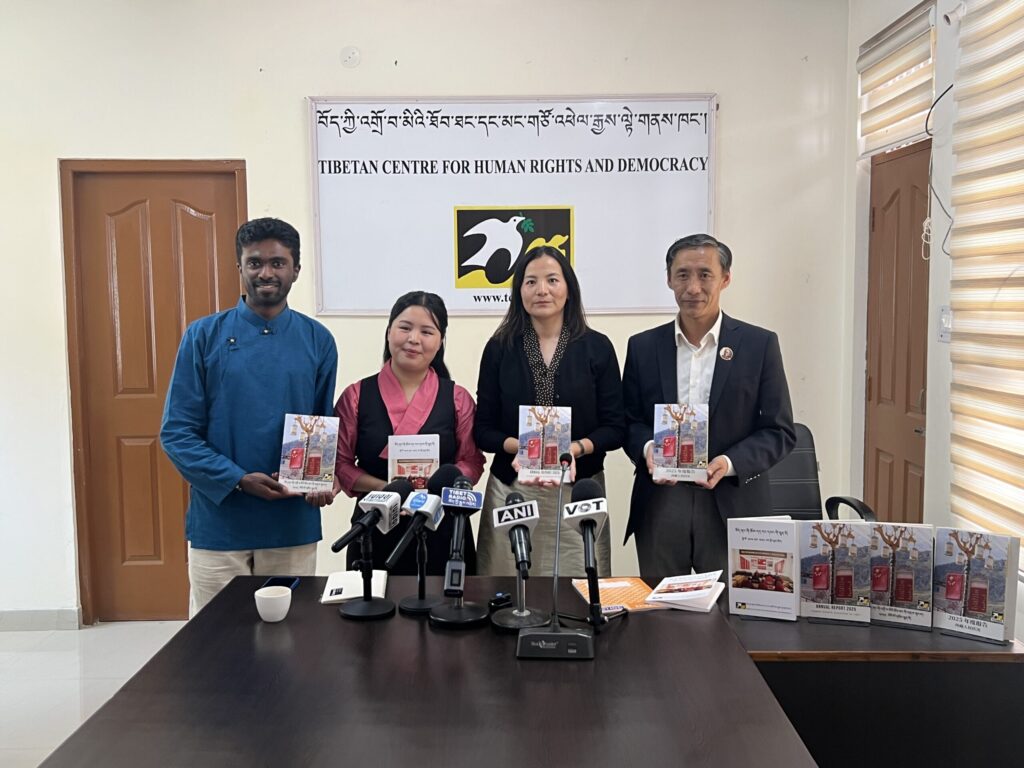
Gaetan Paramagamsan, Intern, Ms Phurbu Dolma, Legal Officer, Ms Tenzin Dawa, Executive Director; Mr Dawa Tashi, Tibetan Researcher; from the Tibetan Centre for Human Rights and Democracy, press release for 2025 Annual Report.