Chinese authorities have imposed an intensive information blackout and administrative crackdown across Tibet following a magnitude 7.0 earthquake that struck Drachen (Ch: Baqen) County in Nagchu Prefecture on 22 October 2026, at approximately 10:33 PM local time.
Local Public Security Bureau are actively suppressing independent updates regarding casualties, coercing forced video confessions, and heavily restricting grassroots humanitarian aid efforts.
While official Chinese state media reports maintain a death toll of 16 with 76 injured, sources on the ground indicate the actual casualties may be significantly higher. Local Tibetans report that Chinese authorities are doing everything possible to cover up the true scale of the disaster, with one source noting that around 50 fatalities were confirmed within their immediate social circle alone.
Following the earthquake, strict security protocols were deployed across Tibet, concentrating heavily on the epicenter in Drachen County and surrounding rural villages. Local Tibetans and volunteers attempting to travel to the affected region to provide emergency humanitarian assistance are being forced to sign pledges agreeing to strict government directives before being permitted entry.
Key restrictions enforced in the disaster zone include:
- Complete prohibition of filming, video recording, or live-streaming conditions from disaster-affected sites.
- Media personnel and volunteers are banned from interviewing affected residents without prior state approval.
- Strict bans on posting unverified earthquake-related information, labeled broadly by state security as “rumors.”
- Prohibition of using photos or videos from the disaster area to solicit independent financial aid or donations for non-governmental organizations.
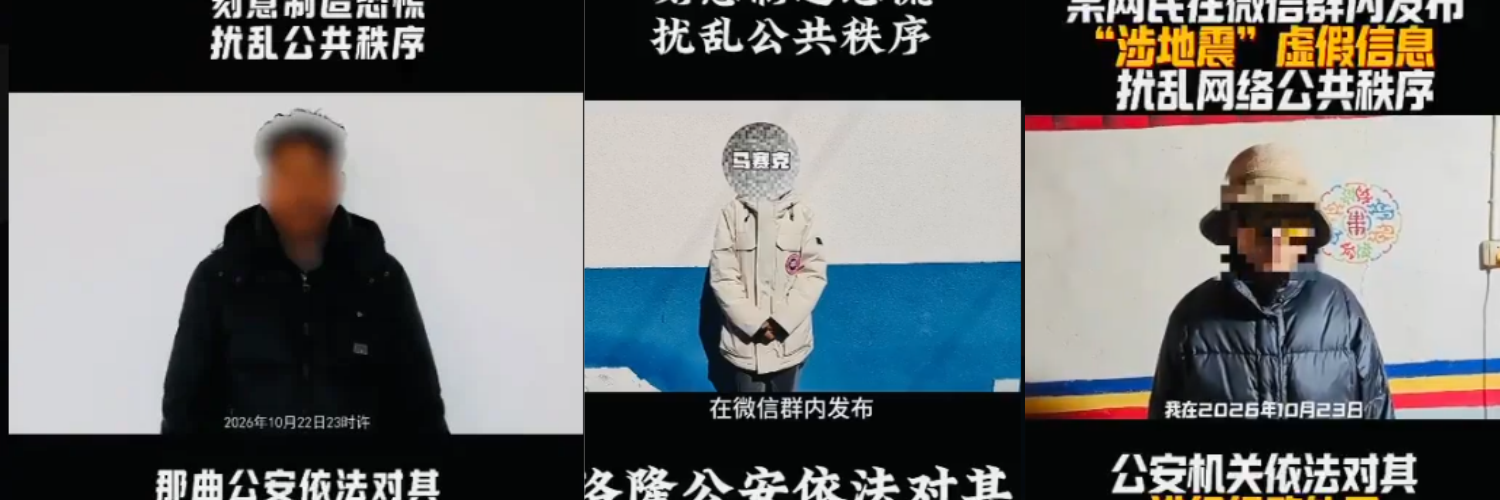
To enforce the information blackout, Public Security Bureau (PSB) offices in Sog (Ch:Suo ) County, Lhorong (Ch:Luolong) County, and Chentsa (Ch: Jianzha) County County have penalized local residents and arrested over ten known Tibetans under charges of “rumor-mongering” and “spreading online rumors.” These Public Security Bureau offices have subsequently posted forced confession videos of several detainees on official police social media channels to intimidate the broader public. In one instance, Lhorong County Public Security Bureau detained a young Tibetan woman and forced her to record a televised confession after she posted in a WeChat group that over 100 people had died in the earthquake. Her current status and whereabouts remain unconfirmed.
In another case, a local Tibetan was detained on the morning of 24 October after stating in a private WeChat group that official reports published by the Sog County Public Security Bureau’s internet police were staged fabrications intended to intimidate the local population. This arrest followed an earlier instance where a Tibetan resident had posted a genuine public safety alert online, warning that the local dam in Dzagseb Township was at risk of breaching and advising nearby villagers to evacuate to higher ground up in the mountains.
Local Public Security Bureau officials are utilizing both administrative penalties and criminal law to penalize Tibetans who bypass state-sanctioned narratives. Under Article 29 of China’s Public Security Administrative Penalty Law, individuals accused by the Public Security Bureau of deliberately spreading rumors or fabricating disaster information face up to 10 days of administrative detention and fines up to 1,000 RMB ($148 USD). Under China’s Criminal Law, individuals convicted of fabricating or knowingly spreading false disaster information that “seriously disrupts social order” face up to three years in prison, with severe cases carrying sentences of three to seven years. Detainees released by the Public Security Bureau thus far have suffered physical beatings, monetary fines, and forced video confessions before being discharged.
During natural disasters that claim lives and devastate communities, state efforts must prioritize saving lives and ensuring transparent communication over criminalizing free speech. In the wake of a disaster that has inflicted severe loss and trauma, the Chinese government and its local Public Security Bureau offices must enable independent access to information. While ensuring public accuracy during crises is essential, the most effective means to counter inaccuracies is through reliable, transparent state communication and upholding freedom of expression. Penalizing residents for attempting to alert neighbors to infrastructure threats or for seeking information about loved ones only heightens public distress and hinders vital humanitarian aid efforts.
The Tibetan Centre for Human Rights and Democracy (TCHRD) calls on the Chinese government and local Public Security Bureau authorities to ensure full transparency regarding disaster casualties, guarantee independent access to information, immediately release all individuals detained for sharing disaster-related updates, and grant unrestricted access to independent aid organizations and journalists to the affected regions in Nagchu.