Chinese authorities have resumed demolitions at Larung Gar Buddhist Institute, the world’s largest Tibetan Buddhist institute, targeting approximately 1,060 monastic quarters belonging to Tibetan Buddhist monks and nuns, according to information received by the Tibetan Centre for Human Rights and Democracy (TCHRD). The demolitions reportedly began on 13 July and are being carried out during the night.
According to the International Campaign for Tibet (ICT), at least six monastic quarters had been demolished as of 15 July, while Chinese authorities have earmarked approximately 1,060 residences for demolition. The latest demolition campaign follows last year’s eviction of around 1,000 monks and nuns from Larung Gar. Authorities cited the absence of proper residential documentation and announced plans to reduce the number of residential houses from 6,000 to the government-set ceiling of 5,000, requiring the demolition of approximately 1,000 monastic quarters.
The renewed demolitions signal that the Chinese government’s campaign against Larung Gar is far from over. It signals the continuation of a long-term policy aimed at reducing the institute’s monastic population, tightening state control over Tibetan Buddhist institutions, and reshaping religious practice in line with the Chinese Communist Party’s (CCP) policy of the Sinicization of religion.
Located in Serthar (Ch: Seda) County in Kardze (Ch: Ganzi) Tibetan Autonomous Prefecture, Sichuan Province, Larung Gar has been the target of repeated state-led demolition and eviction campaigns for more than two decades. Founded by the late Khenpo Jigme Phuntsok in 1980, the institute grew into the world’s largest Tibetan Buddhist institute, attracting an estimated 10,000 monks, nuns, lay practitioners and students from across Tibet, China and abroad. Its reputation as one of the foremost centres of Buddhist learning made it a unique institution within Tibetan Buddhism and a vital centre for preserving Tibetan religious traditions.
The most extensive crackdown began in July 2016, when Chinese government-employed demolition squads systematically destroyed thousands of monastic quarters and forcibly evicted thousands of monks and nuns. A notice issued at the time by the Serthar County government provided detailed, step-by-step instructions for dismantling monastic housing and reducing the institute’s population to a government-set ceiling of 5,000. The campaign fundamentally altered the physical landscape and demographic composition of Larung Gar.
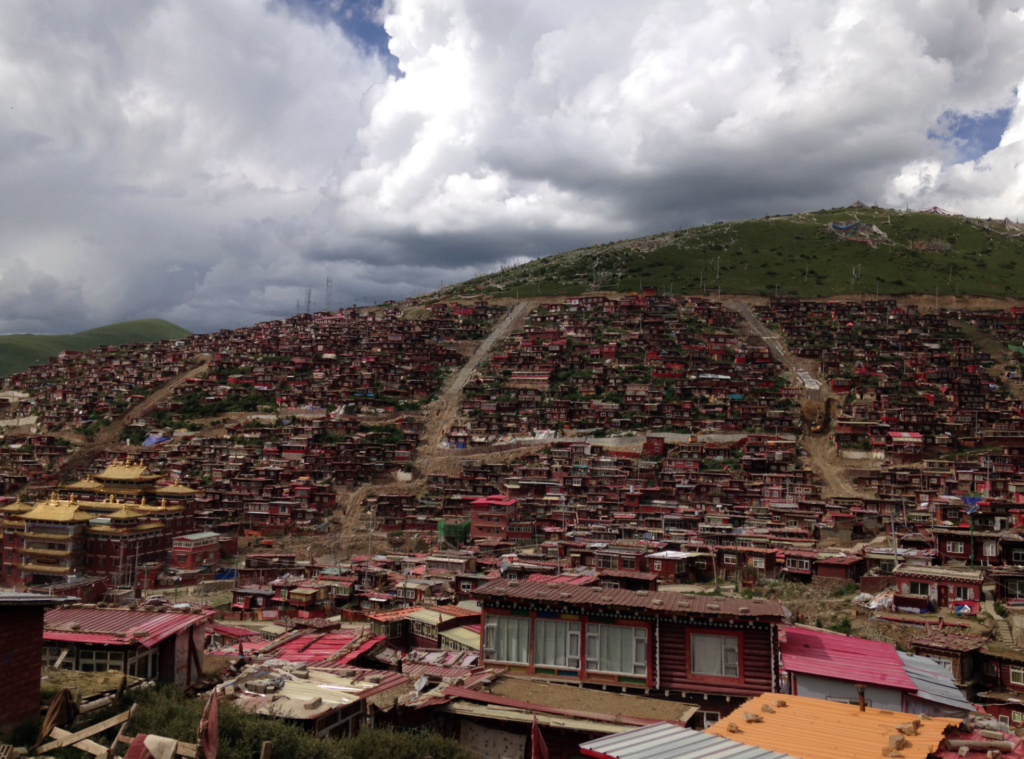
In March 2017, a statement attributed to one of the institute’s abbots and circulated on the Chinese social media platform Weibo confirmed that authorities planned to demolish 3,225 additional monastic quarters by 30 April 2017. By the end of February that year, more than half of the targeted 4,725 houses had already been destroyed. Around 250 monks and nuns from Tsongon (Ch: Qinghai) were forcibly evicted in early April. By the end of May 2017, Chinese authorities had demolished 4,725 monastic quarters and evicted 4,828 monks and nuns from the institute.
The 2016–2017 campaign echoed an earlier crackdown in 2001, when Chinese authorities destroyed thousands of monastic dwellings and expelled monks, nuns and lay practitioners. Reports indicated that some residents died from shock, others died by suicide, while many suffered severe psychological trauma. Shortly after the crackdown, Khenpo Jigme Phuntsok died under unexplained circumstances while receiving treatment at a Chinese government hospital in Chengdu.
Larung Gar also occupies a unique place in Tibetan Buddhism because of its commitment to women’s religious education. It established Tibet’s first nunnery to confer the khenmo degree, the female equivalent of the khenpo, the highest academic qualification in Tibetan Buddhist monastic education. Since awarding the first khenmo degrees in 1990, the institute has enabled more than one hundred nuns to attain the highest level of monastic scholarship after approximately thirteen years of rigorous study in Buddhist philosophy and scriptures. For many Tibetan women, particularly those who are widowed, divorced, disabled or otherwise socially vulnerable, Larung Gar has also served as an important source of education, spiritual guidance and social support.
The demolition campaign has had devastating consequences. On 19 July 2016, two Tibetan nuns, Tsering Dolma and Semgha died by suicide after hanging themselves in their quarters in the Pema Khando Nuns’ Residence amid the demolition campaign. Demolition squads began dismantling the nuns’ residential area on 20 July 2016, and the demolitions continued until early May 2017.
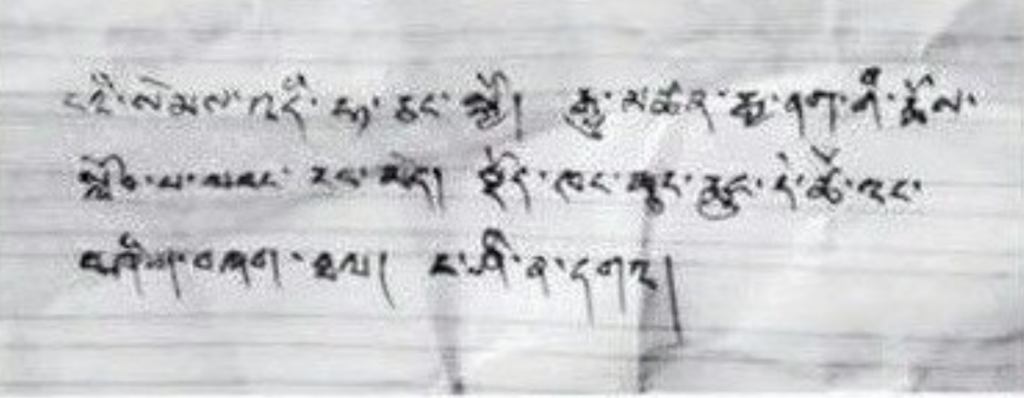
Alongside the demolitions, Chinese authorities have fundamentally transformed the governance structure of Larung Gar. Following the 2016 crackdown, authorities appointed CCP members to key leadership positions responsible for the institute’s management and day-to-day operations. The appointments formed part of an eight-point directive issued by local authorities, which provided detailed instructions on dismantling monastic housing, reducing the monastic population and restructuring the institute’s administration. By subordinating the institute’s religious leadership to Party-appointed officials, Chinese authorities significantly eroded Larung Gar’s long-standing tradition of monastic self-governance.
The latest demolition campaign comes amid a marked deterioration in the right to freedom of religion or belief in Tibet under Chinese President Xi Jinping. Since Xi launched the policy of the Sinicization of religion, Tibetan Buddhist institutions have experienced unprecedented levels of state interference. Monasteries and religious institutes across Tibet have been subjected to intensified political education campaigns, heightened surveillance, restrictions on religious education and monastic enrolment, tighter controls over the recognition of reincarnate lamas, and the expansion of Party-led administrative mechanisms designed to ensure ideological conformity with CCP policies.
The repeated demolition of monastic quarters, mass evictions, imposition of Party-led governance structures and restrictions on residency demonstrate that the Chinese government’s objective extends beyond reducing the institute’s physical size. Rather, these measures are aimed at dismantling autonomous centres of Tibetan Buddhist learning and replacing traditional systems of religious authority with direct Party control.